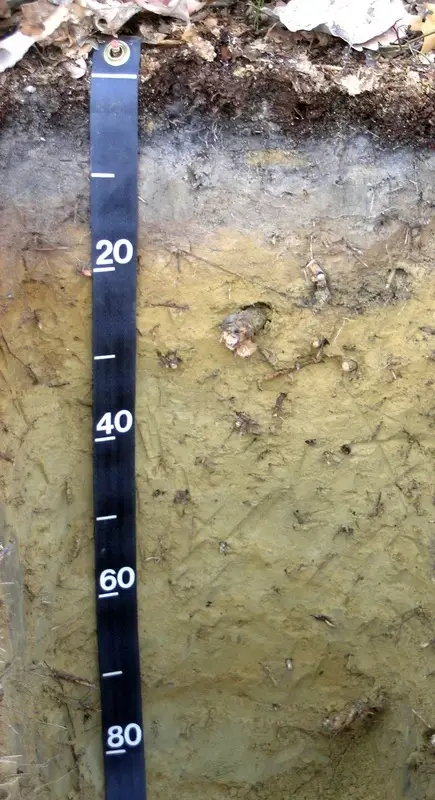
The soil forming factors supply the initial material and conditions under which a particular soil will form. The soil forming processes result from the interactions of the soil forming factors. These processes influence and even create a soil’s physical and chemical properties.
Introduction
Soils are important because they perform many important functions, including:
Sustaining biological activity, diversity, and productivity
Regulating and partitioning water and solute flow
Filtering, buffering, degrading, immobilizing and detoxifying organic & inorganic materials
Storing and cycling nutrients and other elements
Providing support of socioeconomic structures
1. Functions of Soils
Soils vary from place to place due to differences in their Soil forming factors, Soil forming processes, and/or Soil properties:
Photograph Credit: Schoenagel III, Fred C. NRCS, Resource Soil Scientist & Robinson, Timothy J. BSCD, Natural Resource Specialist “Downer Soil Profile” 2013. Photograph. Tabernacle, New Jersey.
Phases of Soil
In their natural setting, soils exist as a “three-phase” system comprised of a:
“solid phase” – the soil matrix; includes inorganic material with various chemical and mineralogical properties, and organic material in varying degrees of decomposition
“liquid phase” – the soil solution; includes soil water and its dissolved substances
“gaseous phase” – the soil air; more variable in composition than the air above the soil
An ideal soil contains:
50% solid matter, of which 45% is mineral soil material and 5% is organic soil material
50% pore space, of which 25% is soil water and 25% is soil air